Use the links below to access information regarding Williamsville Central Schools:
Online Street Directory - http://www.williamsvillek12.org/streets.cfm
(type in street name to determine which school (s) the house is zoned for)
Student Registration - http://www.williamsvillek12.org/departments.cfm?subpage=504
(phone numbers nad forms to register for school)
NYS School Report Cards - http://www.williamsvillek12.org/academics.cfm?subpage=1124
(Most recent data on school performance across the state)
Open Enrollement for 2012-2013 School Year is as follows:
Open enrollment is the opportunity for students who live in the Williamsville Central School District to attend a school within the District that is outside of the student’s residential attendance area. Each school year, the Board of Education decides which schools will be available for open enrollment in the following school year, based primarily on anticipated enrollments. If a school is expected to be near or at capacity, the school may be “closed” to any students who reside outside its designated attendance area.
The Office of Student Services must receive written requests for open enrollment for the 2012-13 school year by February 1, 2012 for all school levels. New this year, all parents must submit a letter requesting open enrollment, including parents of eighth graders who, in the past, simply submitted a district form. Now, they too will need to submit the form and write a letter of request before the February 1st deadline. Please contact your child’s current school of attendance for more information, or call the Office of Student Services at 716-626-8007.
For the 2012-13 school year, North High School, Mill Middle School, Transit Middle School, and all elementary schools except Forest Elementary are closed and not available for open enrollment.
Monday, January 30, 2012

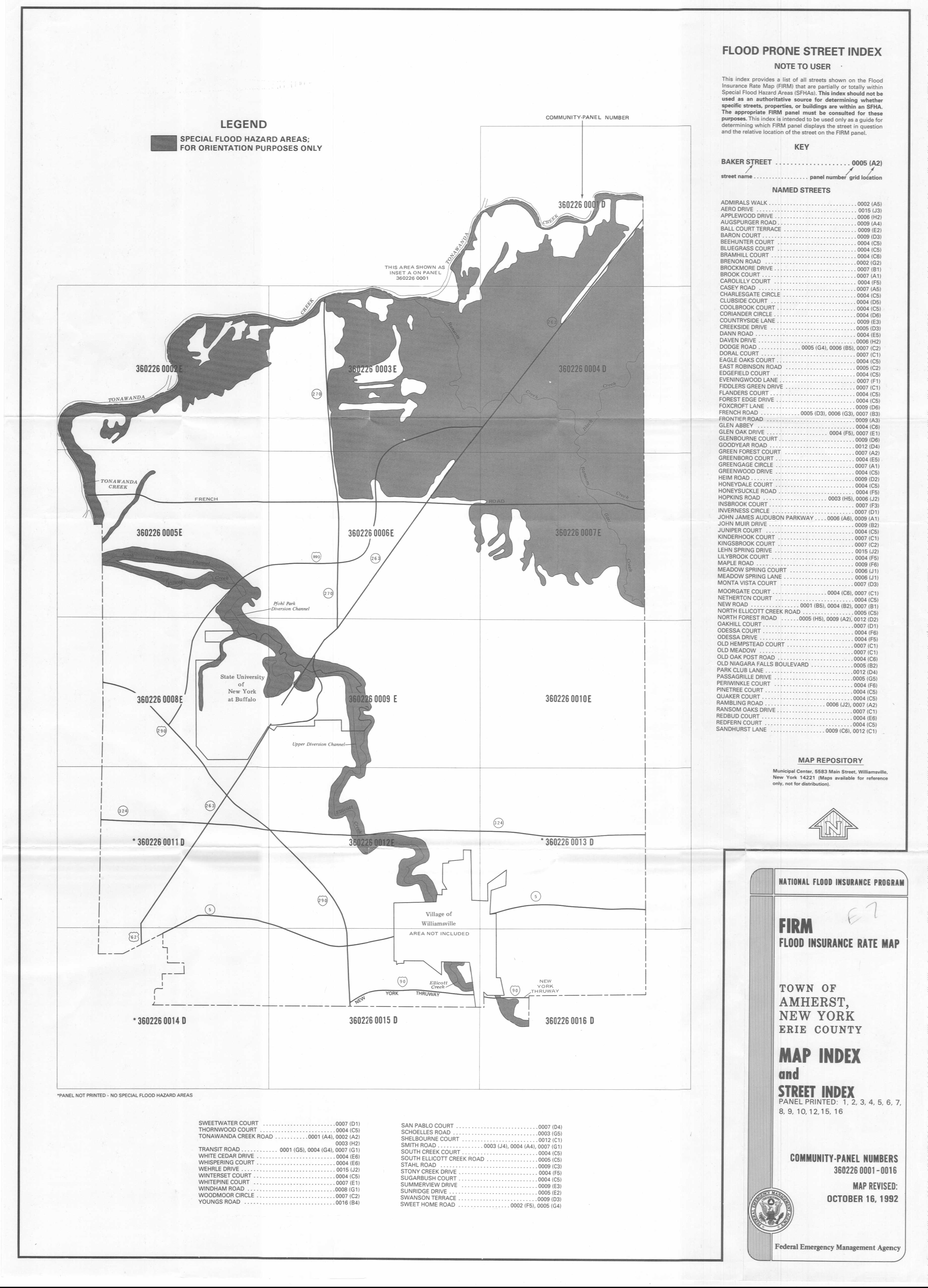
Town of Amherst Flooding Information
Please use the resource below to access flood zone information for the Town of Amherst, NY:
Town of Amherst Annual Flood Letter - http://www.amherst.ny.us/pdf/building/flood/crs_letter.pdf
Town of Amherst Flood Zone Map - http://www.amherst.ny.us/pdf/building/flood/firm_index.jpg
Town of Amherst Flood Info - http://www.amherst.ny.us/govt/govt_dept.asp?dept_id=dept_04&div_id=div_04&menu_id=menu_09
Town of Amherst Request for Flood Information - http://www.amherst.ny.us/pdf/building/forms/fi_determination.pdf
Town of Amherst Annual Flood Letter - http://www.amherst.ny.us/pdf/building/flood/crs_letter.pdf
Town of Amherst Flood Zone Map - http://www.amherst.ny.us/pdf/building/flood/firm_index.jpg
Town of Amherst Flood Info - http://www.amherst.ny.us/govt/govt_dept.asp?dept_id=dept_04&div_id=div_04&menu_id=menu_09
Town of Amherst Request for Flood Information - http://www.amherst.ny.us/pdf/building/forms/fi_determination.pdf
Tuesday, January 10, 2012
FHA Loan Starting Point
Here is some information to get you started below. Remember, when you go to purchase a home as a first time home buyer you can get seller concessions, which means the seller will give you a credit for buying their home up to 6%of the purchase price.
Example if you purchase a home for $100,000 you can get a mortgage for $106,000 with a $6,000 credit for you to use towards closing costs and down payment for a FHA Loan (a government backed loan) which is 3.5% of the purchase price ($3500). This would leave you with your no out of pocket expense for a down payment and $2500 towards the closing costs on your new home.
Some links to help get started with the home buying process:
FHA (Federal Housing Authority) Loan Buyer Overview:
http://portal.hud.gov/hudportal/HUD?src=/program_offices/housing/sfh/fharesourcectr
List of FHA Lenders – I like M and T Bank because they are local and efficient, along with HSBC Bank
http://www.hud.gov/ll/code/llslcrit.cfm
Typical Home Buying Cycle - What are the steps in purchasing a home in New York State:
http://lovallorealestate.blogspot.com/2011/10/typical-home-buying-process-infographic.html
Housing Grants Available:
http://lovallorealestate.blogspot.com/2011_06_01_archive.html
Buyer Agency – why you need someone to represent you as a buyer:
http://lovallorealestate.blogspot.com/2010/07/buyer-agency-why-you-need-it.html
Example if you purchase a home for $100,000 you can get a mortgage for $106,000 with a $6,000 credit for you to use towards closing costs and down payment for a FHA Loan (a government backed loan) which is 3.5% of the purchase price ($3500). This would leave you with your no out of pocket expense for a down payment and $2500 towards the closing costs on your new home.
Some links to help get started with the home buying process:
FHA (Federal Housing Authority) Loan Buyer Overview:
http://portal.hud.gov/hudportal/HUD?src=/program_offices/housing/sfh/fharesourcectr
List of FHA Lenders – I like M and T Bank because they are local and efficient, along with HSBC Bank
http://www.hud.gov/ll/code/llslcrit.cfm
Typical Home Buying Cycle - What are the steps in purchasing a home in New York State:
http://lovallorealestate.blogspot.com/2011/10/typical-home-buying-process-infographic.html
Housing Grants Available:
http://lovallorealestate.blogspot.com/2011_06_01_archive.html
Buyer Agency – why you need someone to represent you as a buyer:
http://lovallorealestate.blogspot.com/2010/07/buyer-agency-why-you-need-it.html
Sunday, October 9, 2011
Typical Home Buying Process Infographic
Click the image for a full size infographic on the Home Buying Process in New York State.

Monday, June 13, 2011
Housing Grants Available
Downpayment and Closing Cost Assistance
There are programs available through local community development offices. You must apply to each program through the office of its provider.
There are programs available through local community development offices. You must apply to each program through the office of its provider.

*Table sources from http://www.belmonthousingwny.org/content/pages/down-payment-closing-cost-assistance
Williamsville Relocation Temporary Housing
Temporary Housing for relocation to Western New York can be a tough road to navigate, due the limited availablity rental options available (as you must compete with all the local university students). Yet, there are several quality options available to you as I describe them below:
1. You can also search http://www.2findyourapartment.com/ for some more information on the rentals in the area. A good portion of our temporary housing for our relocation clients as the search for permanent is housing is booked through
2. You can view http://www.luxuryaptswny.com/index.html and the following communities are located in Amherst: Windsong Place, Autumn Creek and Renaissance.
We have referral accounts setup with each of the communities’ setup, so if you decide to lease we can provide you with a referral code that will discount your first month rent. Best of luck on your relocation!
We have referral accounts setup with each of the communities’ setup, so if you decide to lease we can provide you with a referral code that will discount your first month rent. Best of luck on your relocation!
Scan the qr code below for my profile information.

Sunday, October 17, 2010
Utility Contacts for Buyers
Utility Contact Information
Cable:
Time Warner
(866) 668-6044
Gas/Electric:
National Fuel
(716) 686-6123
(800) 365-3234 (Outside WNY
National Grid
(800) 365-3234
National Grid Coverage Map- http://www.nationalgridus.com/niagaramohawk/about_us/serviceterr_map_a.asp?county=Erie
New York State Electric & Gas (“NYSEG”)
(800) 572-1111 (Press “2” then “1”)
NYSEG Coverage MAP- http://www.nyseg.com/MediaLibrary/2/5/Content%20Management/NYSEG/YourHome/PDFs%20and%20Docs/NYSEG%20Service%20Area%20Map.pdf
Telephone:
Verizon
(716) 890-7100 (Press “2”)
Water - Erie County Water Authority:
Erie County Water Authority (716) 849-8444
Amherst
Cheektowaga
Clarence
Depew
Depew, Village of
Hamburg
Lackawanna
Lancaster, Town of
Lancaster, Village of
Marilla
Newstead
Orchard Park, Town of
Tonawanda
West Seneca
Water - Other Erie County Municipalities:
Angola
(716) 549-1126
Blasdell
(716) 822-1921
Buffalo, City of
(716) 847-1079
East Aurora
(716) 652-6057
Elma, Town of
(716) 674-8855
Evans, Town of
(716) 549-5751
Grand Island, Town of
(716) 773-9663
Kenmore, Village of
(716) 873-5700
Orchard Park, Village of
(716) 662-9327
Tonawanda, Town of
(716) 871-8843
Williamsville, Village of
(716) 632-5009
Water - Niagara County Municipalities:
Each town and village has its own water department. Contact applicable municipality (see blue pages in telephone directory).
Cable:
Time Warner
(866) 668-6044
Gas/Electric:
National Fuel
(716) 686-6123
(800) 365-3234 (Outside WNY
National Grid
(800) 365-3234
National Grid Coverage Map- http://www.nationalgridus.com/niagaramohawk/about_us/serviceterr_map_a.asp?county=Erie
New York State Electric & Gas (“NYSEG”)
(800) 572-1111 (Press “2” then “1”)
NYSEG Coverage MAP- http://www.nyseg.com/MediaLibrary/2/5/Content%20Management/NYSEG/YourHome/PDFs%20and%20Docs/NYSEG%20Service%20Area%20Map.pdf
Telephone:
Verizon
(716) 890-7100 (Press “2”)
Water - Erie County Water Authority:
Erie County Water Authority (716) 849-8444
Amherst
Cheektowaga
Clarence
Depew
Depew, Village of
Hamburg
Lackawanna
Lancaster, Town of
Lancaster, Village of
Marilla
Newstead
Orchard Park, Town of
Tonawanda
West Seneca
Water - Other Erie County Municipalities:
Angola
(716) 549-1126
Blasdell
(716) 822-1921
Buffalo, City of
(716) 847-1079
East Aurora
(716) 652-6057
Elma, Town of
(716) 674-8855
Evans, Town of
(716) 549-5751
Grand Island, Town of
(716) 773-9663
Kenmore, Village of
(716) 873-5700
Orchard Park, Village of
(716) 662-9327
Tonawanda, Town of
(716) 871-8843
Williamsville, Village of
(716) 632-5009
Water - Niagara County Municipalities:
Each town and village has its own water department. Contact applicable municipality (see blue pages in telephone directory).
Monday, July 26, 2010
Buyer Agency - Why you need it?
We are constantly fielding calls from prospective buyers with regards to questions about our properties we have listed. Most buyers are very open with regards to communication, and are going about the home search process alone. Very few buyers understand they need and advantage of having a licensed agent represent them as a buyer's agent. Buyer agency is defined as a principal-agent relationship in which the broker is the agent for a buyer, with fiduciary responsibilities to the buyer. What does that mean? It means that a buyer's agent is tied to the buyer, and all of your loyalties are to the buyer. (nothing to do with seller's agent) So why do so many buyers go out and purchase homes without a buyer's agent?
Buyer agency is a relatively new concept for the real estate world. In the past, agents were Seller's Agents, working for the person who signed a contract employing them to sell real estate. Over time that arrangement resulted in too many misunderstandings. A buyer working with a Seller's Agent often regarded that person as his agent, and felt free to make confidential statements, not understanding they would be passed on to the seller.
As a result, New York State require us to explain agency status to the buyer. In addittion, most seller's agree to pay a buyer's agency fee as it is an established part of their MLS Listing Agreement. Therefore, it comes at no cost to the buyer.
In today's real estate world, you'll find agents who work as Seller's Agents and Buyer's Agents, and in some areas you'll see Dual Agents and Designated Agents. Here's a simplified recap of those terms.
Seller's Agent
Your duty is to obtain the best deal for the seller. You are allowed to give the buyer only material facts about the property.
Buyer's Agent
Your duty is to obtain the best deal for the buyer. You may pass on any and all information you obtain about the seller or the property.
Dual Agent
You must be loyal to both parties. Dual agency occurs when a real estate agency owns a listing, and an agent from the office, working as a buyer's representative, shows that listing.
Dual Agency must be disclosed and agreed-to in writing by both parties, since it's sometimes difficult to focus on the needs of one client versus the other.
Designated Agent
Very similar to Dual Agency. The broker-in-charge designates two agents to work a transaction, one for the seller, one for the buyer.
Buyer agency is a relatively new concept for the real estate world. In the past, agents were Seller's Agents, working for the person who signed a contract employing them to sell real estate. Over time that arrangement resulted in too many misunderstandings. A buyer working with a Seller's Agent often regarded that person as his agent, and felt free to make confidential statements, not understanding they would be passed on to the seller.
As a result, New York State require us to explain agency status to the buyer. In addittion, most seller's agree to pay a buyer's agency fee as it is an established part of their MLS Listing Agreement. Therefore, it comes at no cost to the buyer.
In today's real estate world, you'll find agents who work as Seller's Agents and Buyer's Agents, and in some areas you'll see Dual Agents and Designated Agents. Here's a simplified recap of those terms.
Seller's Agent
Your duty is to obtain the best deal for the seller. You are allowed to give the buyer only material facts about the property.
Buyer's Agent
Your duty is to obtain the best deal for the buyer. You may pass on any and all information you obtain about the seller or the property.
Dual Agent
You must be loyal to both parties. Dual agency occurs when a real estate agency owns a listing, and an agent from the office, working as a buyer's representative, shows that listing.
Dual Agency must be disclosed and agreed-to in writing by both parties, since it's sometimes difficult to focus on the needs of one client versus the other.
Designated Agent
Very similar to Dual Agency. The broker-in-charge designates two agents to work a transaction, one for the seller, one for the buyer.
Monday, June 7, 2010
Energy Payback Projects
Energy Payback Projects for Homeowners:
Project With Immediate Payback (0 to 6 months)
Install a Programmable Thermostat
Turning down the thermostat 7 degrees at bedtime will knock 10 percent off your heating costs, but who wants to wake up to a frigid house? A programmable thermostat automatically drops the heat at night and cranks it up in the morning, so the house is warm before your alarm clock rings. Program it to lower the heat again while you’re at work and the kids are in school all day and you’ll reap additional savings. Best of all, many of these battery-operated units are easy to install yourself.
COST: $30 to $80
PAYBACK: $100 to $250 per year
Project With Short-Term Payback (1 to 3 years)
Beef Up Attic Insulation“Heat rises, so adding insulation to the attic floor is one of the best energy retrofits you can do,”
COST: $300 (to add 3 inches of fiberglass insulation to a 1,000-square-foot attic floor) * some insulation products are eligible for 30 percent tax credit under the American Recovery and Reinvestment Act of 2009 (link)
PAYBACK: $150 to $300 a year for the average home heated with natural gas, $350 to $700 for oil heat.
Projects with Long-Term Payback (5 or more years)
Upgrade to Energy-Efficient Appliances
Energy Star appliances consume 10 to 50 percent less electricity than standard appliances sold today, and if you’re replacing equipment that is older than 10 years, the energy savings will be even greater. Refrigerators and clothes washers are two of the biggest household energy guzzlers. A new Energy Star fridge uses half the energy of a machine made a decade ago; a front-load washer uses 35 percent less electricity than an old top-mount, plus it consumes less hot water and spins the clothes so effectively that you save money on dryer operating costs, too.
COST: $600 to $1,400 for a front-load clothes washer; $1,000 to $3,000 for an Energy Star refrigerator
PAYBACK: $145 a year in electricity savings for the washer, plus gallons of water saved on every load; $60 a year for the refrigerator
Project With Immediate Payback (0 to 6 months)
Install a Programmable Thermostat
Turning down the thermostat 7 degrees at bedtime will knock 10 percent off your heating costs, but who wants to wake up to a frigid house? A programmable thermostat automatically drops the heat at night and cranks it up in the morning, so the house is warm before your alarm clock rings. Program it to lower the heat again while you’re at work and the kids are in school all day and you’ll reap additional savings. Best of all, many of these battery-operated units are easy to install yourself.
COST: $30 to $80
PAYBACK: $100 to $250 per year
Project With Short-Term Payback (1 to 3 years)
Beef Up Attic Insulation“Heat rises, so adding insulation to the attic floor is one of the best energy retrofits you can do,”
COST: $300 (to add 3 inches of fiberglass insulation to a 1,000-square-foot attic floor) * some insulation products are eligible for 30 percent tax credit under the American Recovery and Reinvestment Act of 2009 (link)
PAYBACK: $150 to $300 a year for the average home heated with natural gas, $350 to $700 for oil heat.
Projects with Long-Term Payback (5 or more years)
Upgrade to Energy-Efficient Appliances
Energy Star appliances consume 10 to 50 percent less electricity than standard appliances sold today, and if you’re replacing equipment that is older than 10 years, the energy savings will be even greater. Refrigerators and clothes washers are two of the biggest household energy guzzlers. A new Energy Star fridge uses half the energy of a machine made a decade ago; a front-load washer uses 35 percent less electricity than an old top-mount, plus it consumes less hot water and spins the clothes so effectively that you save money on dryer operating costs, too.
COST: $600 to $1,400 for a front-load clothes washer; $1,000 to $3,000 for an Energy Star refrigerator
PAYBACK: $145 a year in electricity savings for the washer, plus gallons of water saved on every load; $60 a year for the refrigerator
Sunday, June 6, 2010
Introducting our Online Mortgage Center
LoVallo Real Estate has recently formed an exclusive relationship with Bank of America to offer our client's access to an Online Mortgage Center. This Online Mortgage Center "OMC" will serve as a great resource for buyers to take them through all the stages of the loan qualification and closing. This will serve as a one-stop destination for pre-qualification and mortgage approval. Visit the Bank of America Online Mortgage Center Today at http://www.lovallorealestate.com/web/pgcnfID_105666/Mortgage-Center
Monday, January 11, 2010
Extended Homebuyer Credit
As the new year has come and gone, questions are still arising everyday with regards to the First Time Home Buyer Credit. This past year was a great year to be a first time homebuyer! Yet, it is gets even better if you are looking to move up. As most people are aware of the $6500 credit for current homeowners, here is a link to the IRS page that explains the credit and answers the common questions.
http://www.irs.gov/newsroom/article/0,,id=206291,00.html
http://www.irs.gov/newsroom/article/0,,id=206291,00.html
Wednesday, January 6, 2010
Sustainable Neighborhoods Project
In today's State of the State address, Governor David Paterson not only recognized Buffalo's struggle with abandoned housing, but he has put the City of Buffalo first in line, saying, "With more than 23,000 vacant housing units, Buffalo will serve as the starting point for the project which will expand to cities across New York State."
Governor Paterson proposes the Sustainable Neighborhoods Project as a national model for affordable housing and urban revitalization, starting here.
Resulting from decades of post-industrial economic decline that have exacerbated the vacant housing crisis, together with the foreclosure and sub-prime crises, Paterson understands the negative impact this has on future economic development, homeownership and in-migration. The abandoned houses and ravaged, once vital neighborhoods serve to perpetuate "the perception that the region's urban areas are in a downward spiral," according to Paterson.
"There is no other region of the country with the affordable housing stock, the close-by schools, the natural beauty and the untouched small towns that families would cherish. We need to return to promoting all that we have to offer," Governor Paterson said. "Part of that effort must include revitalizing prime housing stock that currently sits vacant and turning it into long-term affordable housing, starting in Buffalo..."
In Paterson's plan, local officials will designate blighted homes for rehabilitation and sale to first time homeowners; houses will be marketed as long-term affordable housing and homeowners would be selected through a lottery process. The City of Buffalo has not issued a statement about the governor's remarks as of yet.
In a more holistic approach, PUSH Buffalo's Eric Walker says, "We are eager to work with the Governor to build a national model for sustainable community development incorporating green jobs training, green rehab, weatherization and urban agriculture. We think Buffalo can lead the way in demonstrating that urban neighborhoods have tremendous assets, including arable land and residents who are eager to participate in the New Economy."
Other projects on the table for that neighborhood include a rehabilitated park and more green housing in 2010. "We look forward to working with the Governor to implement the new investment in the Neighborhood," said Aaron Bartley, PUSH Executive Director. "We are very excited to explore the avenues opened to us by this partnership with the Governor."
The proximity to newly renovated schools for many of these houses all over the city, but most especially on the East and West Sides, should help the schools to maintain the students they need, through bringing in families that are willing to be part of revitalized school communities with revitalized housing stock.
Thanks to http://www.buffalorising.com/2010/01/paterson-on-sustainable-neighborhoods-project.html#SlideFrame_5
Governor Paterson proposes the Sustainable Neighborhoods Project as a national model for affordable housing and urban revitalization, starting here.
Resulting from decades of post-industrial economic decline that have exacerbated the vacant housing crisis, together with the foreclosure and sub-prime crises, Paterson understands the negative impact this has on future economic development, homeownership and in-migration. The abandoned houses and ravaged, once vital neighborhoods serve to perpetuate "the perception that the region's urban areas are in a downward spiral," according to Paterson.
"There is no other region of the country with the affordable housing stock, the close-by schools, the natural beauty and the untouched small towns that families would cherish. We need to return to promoting all that we have to offer," Governor Paterson said. "Part of that effort must include revitalizing prime housing stock that currently sits vacant and turning it into long-term affordable housing, starting in Buffalo..."
In Paterson's plan, local officials will designate blighted homes for rehabilitation and sale to first time homeowners; houses will be marketed as long-term affordable housing and homeowners would be selected through a lottery process. The City of Buffalo has not issued a statement about the governor's remarks as of yet.
In a more holistic approach, PUSH Buffalo's Eric Walker says, "We are eager to work with the Governor to build a national model for sustainable community development incorporating green jobs training, green rehab, weatherization and urban agriculture. We think Buffalo can lead the way in demonstrating that urban neighborhoods have tremendous assets, including arable land and residents who are eager to participate in the New Economy."
Other projects on the table for that neighborhood include a rehabilitated park and more green housing in 2010. "We look forward to working with the Governor to implement the new investment in the Neighborhood," said Aaron Bartley, PUSH Executive Director. "We are very excited to explore the avenues opened to us by this partnership with the Governor."
The proximity to newly renovated schools for many of these houses all over the city, but most especially on the East and West Sides, should help the schools to maintain the students they need, through bringing in families that are willing to be part of revitalized school communities with revitalized housing stock.
Thanks to http://www.buffalorising.com/2010/01/paterson-on-sustainable-neighborhoods-project.html#SlideFrame_5
Sunday, August 16, 2009
New York State Federal Income Tax Credit
GOVERNOR PATERSON ANNOUNCES FEDERAL INCOME TAX CREDIT FOR FIRST-TIME HOME BUYERS Tax Credit Could Save the Average Homebuyer Approximately $1,500 Each Year Credit Will Help Stimulate Home Sales in New York StateGovernor David A. Paterson today announced that New York will offer a federal income tax credit to first-time homebuyers to encourage home sales in the State. The New York State Mortgage Credit Certificate (MCC) will enable first-time homebuyers to claim a tax credit equal to 20% of their annual mortgage interest costs, potentially saving the average homebuyer about $1,500 each year. The program will effectively extend, and in some cases improve upon the federal government’s $8,000 First-Time Homebuyer Credit enacted as part of the American Recovery and Reinvestment Act of 2009, which expires on November 30th.“The best way to jump-start the housing market is to encourage home purchases by first-time homebuyers,” Governor Paterson said. “The New York State Mortgage Credit Certificate will make it easier for first-time homebuyers to buy their first home and will help stimulate the State’s economy. It also means some form of federal tax credit will be available for homebuyers even after the federal government’s tax credit program expires in November.”The New York State Mortgage Credit Certificate (MCC) can be used to reduce a homebuyer’s tax burden for every year the mortgage loan remains outstanding. With an MCC, 20% of the amount paid in mortgage interest becomes a tax credit that can be deducted, dollar for dollar, from a homeowner’s federal income tax liability. The remaining 80% of the mortgage interest continues to qualify as an itemized tax deduction, as long as there is sufficient federal tax liability. The MCC will be administered by the State of New York Mortgage Agency (SONYMA), a State agency that offers a variety of fixed-rate mortgages tailored to the needs of first-time homebuyers.Priscilla Almodovar, SONYMA President and Chief Executive Officer, said: “Offering a federal tax credit is a powerful incentive to bring first-time homebuyers into the market and it helps with a family’s cash flow needs. This program will help stabilize housing prices and at the same time further Governor Paterson’s goal of promoting sustainable homeownership for working families.”Prospective homebuyers should apply for the Mortgage Credit Certificate when they apply for a fixed-interest rate mortgage from a participating lending institution. MCC applicants will be required to meet SONYMA’s income and purchase price limits, which can be found at http://www.nyhomes.org. However, homebuyers who obtain a SONYMA mortgage will not be eligible to apply for the Mortgage Credit Certificate tax credit.MCC applications are expected to be available at participating lenders by early September. In addition, homebuyers who have already obtained a mortgage commitment can apply at their bank for an MCC if they have not yet closed on their new home. SONYMA anticipates that MCCs will be used by as many as 700 borrowers in 2009.Borrowers who are approved for an MCC will be able to take advantage of the credit when they file their annual federal tax return. If a homebuyer’s tax liability is less than the Mortgage Credit Certificate credit in any one year, the amount of unused tax credit can be carried forward for up to three years. In the first year of ownership, a homeowner with a $150,000 loan at a 5.5% interest rate will likely pay $8,200 in interest on his or her mortgage. With an MCC, the homeowner can claim 20% of the interest, or $1,640, as a direct tax credit resulting in a savings of $137 per month. As long as he or she continues to occupy the property, the average homeowner can save approximately $1,520 per year over the first 10 years.Mortgage Credit Certificates are financed through the use of New York State’s private activity bonding authority. The IRS allows states to convert $4 in bonding authority, or volume cap, for every $1 approved in MCC tax credits. NYS plans to use $80 million in volume cap to finance $20 million in MCC tax credits. In addition to the MCC, borrowers can also claim up to $8,000 with the Federal First-Time Homebuyer Credit enacted as part of the U.S. American Recovery and Reinvestment Act of 2009. The Federal First-Time Homebuyer Credit is available to first-time homebuyers who purchase a home between January 1, 2009 and November 30, 2009. For more information on the Federal First-Time Homebuyer Credit, please visit http://www.treas.gov/press/releases/tg39.htm.Philip LaRocque, Executive Vice President of the New York State Builders, said: “We welcome the New York State Mortgage Credit Certificate offering as an important step in bringing more new and existing homebuyers to this very challenging housing market. A housing industry recovery always leads us out of recession and this MCC should help stimulate new and existing home sales in New York State therefore helping move the industry in a positive direction.”Daniel J. Hartnett, President of the New York State Association of REALTORS(r), said: “We applaud Governor Paterson for his vision in creating the Mortgage Credit Certificate program and for recognizing the importance of housing as a primary driver of the Empire State's economy. The past four months of increasing home sales across the State have proven the value of buyer incentives. We expect, when coupled with the federal first-time buyer credit of $8,000, the MCC will bring additional buyers back to the market and further boost the recovery of both the State's housing market and economy.”Deborah Boatright, Northeast District Director, NeighborWorks® America said: “The Mortgage Credit Certificate is an innovative and powerful incentive that will make homeownership more affordable and sustainable for low- and moderate- income families. Research shows that responsible, sustainable homeownership enables families to build assets, move up the economic ladder and provide greater stability for their children while helping to stabilize communities. NeighborWorks® America applauds Governor Paterson and SONYMA for creating this important new mechanism to spur homeownership.” The State of New York Mortgage Agency was created in 1970 with the mission of helping low- and moderate-income families become homeowners. It offers a variety of low down payment mortgages that provide competitive fixed interest rates, as well as assistance with down payments through a network of participating lenders across the State. For details on MCC income limits, purchase price limits and participating lenders, please visit http://www.nyhomes.org/.
Monday, August 3, 2009
First Time Homebuyer Guide
The amount of information available for first time home buyer's is overwhelming. The life-changing process of acquiring a new home is very time consuming.
The New York Home Buyer Education Program does a great job explaining the process. The offer seminars across the state and seminars to help educate home buyers.
The link below is an amazing guide on the home buyer process. It is 52 pages long and covers all the aspects of home buying. Categories covered in the .pdf link are home searching, loan pre-approvals, financing, closing procedures and the overall process. It is such great resource, we send this to every client we have to help explain the home-buying process.
Check out the Home Buyer Education Program Workbook on the link below:
http://portal.hud.gov/portal/page/portal/HUD/topics/buying_a_home
The New York Home Buyer Education Program does a great job explaining the process. The offer seminars across the state and seminars to help educate home buyers.
The link below is an amazing guide on the home buyer process. It is 52 pages long and covers all the aspects of home buying. Categories covered in the .pdf link are home searching, loan pre-approvals, financing, closing procedures and the overall process. It is such great resource, we send this to every client we have to help explain the home-buying process.
Check out the Home Buyer Education Program Workbook on the link below:
http://portal.hud.gov/portal/page/portal/HUD/topics/buying_a_home
Tuesday, July 14, 2009
Home Affordability Peaks in Buffalo, NY
Home Affordability has not been this good in decades. Actually, make that two (2) decades. Homes are extremely affordable at this time in the market.
What is great is that Buffalo Area Region ranks among the Top 10 for Most Affordable Housing!
Yes, the Buffalo region (out of the 100 largest regions in the United States) ranked in the Top 10 for affordable housing. That is great news for first time home buyers or current renters. Literally, there has not been a better time in 20 years to buy a home. With all the tax incentives, financing options, and new regulations it seems now is the time to act with regards to real estate.
So what do you think? Is our area affordable? What would an average house in our area be worth in another state? See how our area ranks with other affordable areas, along with the least affordable areas to live. Let us know what you think!
Check out CNN Money magazine link at http://money.cnn.com/2009/05/18/real_estate/most_affordable_cities/index.htm?postversion=2009051907
What is great is that Buffalo Area Region ranks among the Top 10 for Most Affordable Housing!
Yes, the Buffalo region (out of the 100 largest regions in the United States) ranked in the Top 10 for affordable housing. That is great news for first time home buyers or current renters. Literally, there has not been a better time in 20 years to buy a home. With all the tax incentives, financing options, and new regulations it seems now is the time to act with regards to real estate.
So what do you think? Is our area affordable? What would an average house in our area be worth in another state? See how our area ranks with other affordable areas, along with the least affordable areas to live. Let us know what you think!
Check out CNN Money magazine link at http://money.cnn.com/2009/05/18/real_estate/most_affordable_cities/index.htm?postversion=2009051907
Monday, June 22, 2009
Town of Amherst Reassessment Project Information
Get Ready Amherst - The Town of Amherst Reassessment Project is now entering its final stages. New Market Value Assessments have been mailed in the Assessment Disclosure Notices to all of the property owners in the Town. This Notice states the current Property Assessment, our Preliminary Assessment and the estimated effect this change would have had on the Tax Liability to each parcel if all of the Assessments had been in place to calculate the September 2008 School and the January 2009 Town and County tax bills.
Use the link below to access all the information you need to research the Town of Amherst Reassessment Project. The link will also give you sales data for the past several years for the town and necessary forms to complete with the town for various situations.
http://www.amherst.ny.us/govt/it/cpi/cpi_reassess.asp
Use the link below to access all the information you need to research the Town of Amherst Reassessment Project. The link will also give you sales data for the past several years for the town and necessary forms to complete with the town for various situations.
http://www.amherst.ny.us/govt/it/cpi/cpi_reassess.asp
Saturday, June 13, 2009
Extend the First Time Home Buyer Credit
Do you want to see the First Time Home Buyer Tax Credit extended? If YES, you might just get your wish. Recent legislation has been introduced to create that extension.
Worried that rising mortgage rates could damp the prospects for a housing recovery, a business group is making a new push for Congress to boost and extend a home-buyer tax credit.
In February, Congress approved a 10% tax credit for first-time home purchases, up to a maximum of $8,000. The credit, which expires Dec. 1, phases out for buyers with incomes above $170,000 for married couples and $95,000 for individuals.
The National Association of Home Builders and other industry groups have long argued that the credit isn't large enough to help reinvigorate the housing sector. Now the groups are being joined in their efforts by the Business Roundtable, an association of chief executives.
The Business Roundtable is calling on Congress to increase the credit to $15,000 and extend it to all home buyers. "What is being billed as a recovery is not showing up in the cash register yet," says Richard A. Smith, chief executive of Realogy Corp. and a member of the Business Roundtable.
The Business Roundtable is also urging policy makers to sustain efforts to keep mortgages at or below 5% for one year. Mortgage rates climbed to 5.74% on Tuesday a six-month high and up from 5.03% two weeks ago, according to HSH Associates, a financial publisher. Rates have fallen since the Federal Reserve stepped up debt purchases earlier this year in an effort to drive down rates.
A buyer typically needs income of $92,000, assuming a 10% down payment, to qualify for a $400,000 30-year fixed-rate mortgage. With rates at 4.5%, the borrower only needs income of around $84,000, according to an estimate by real-estate firm Long & Foster Cos.
The real-estate industry made a similar push for a $22,000 tax credit for all buyers and interest-rate subsidies earlier this year as Congress considered a range of measures to stimulate the economy. Congress instead opted to increase to $8,000 an existing tax credit for first-time buyers.
Business leaders say that while the first-time-buyer credit has succeeded in jump-starting the bottom end of the housing market, more needs to be done to lure "trade-up" buyers back to the market. Realtors and builders argue that boosting sales among existing owners as opposed to first-time buyers will spur more sales because each transaction involves two home sales. "That 'move-up' buyer has got to have somewhere to go," says Mr. Smith, who warns that without more incentives for existing homeowners, the housing market's "stalemate will be nasty and protracted."
The business group's campaign also pushes for Congress to make permanent recently expanded limits for loans eligible for government backing or purchase.
Congress in February boosted those limits to as high as $729,750 in the nation's most expensive housing markets, from $417,000, and the February stimulus bill renewed the higher limits through the end of the year. Those limits are set to expire at the end of the year and are tied to median home prices, which have fallen
Worried that rising mortgage rates could damp the prospects for a housing recovery, a business group is making a new push for Congress to boost and extend a home-buyer tax credit.
In February, Congress approved a 10% tax credit for first-time home purchases, up to a maximum of $8,000. The credit, which expires Dec. 1, phases out for buyers with incomes above $170,000 for married couples and $95,000 for individuals.
The National Association of Home Builders and other industry groups have long argued that the credit isn't large enough to help reinvigorate the housing sector. Now the groups are being joined in their efforts by the Business Roundtable, an association of chief executives.
The Business Roundtable is calling on Congress to increase the credit to $15,000 and extend it to all home buyers. "What is being billed as a recovery is not showing up in the cash register yet," says Richard A. Smith, chief executive of Realogy Corp. and a member of the Business Roundtable.
The Business Roundtable is also urging policy makers to sustain efforts to keep mortgages at or below 5% for one year. Mortgage rates climbed to 5.74% on Tuesday a six-month high and up from 5.03% two weeks ago, according to HSH Associates, a financial publisher. Rates have fallen since the Federal Reserve stepped up debt purchases earlier this year in an effort to drive down rates.
A buyer typically needs income of $92,000, assuming a 10% down payment, to qualify for a $400,000 30-year fixed-rate mortgage. With rates at 4.5%, the borrower only needs income of around $84,000, according to an estimate by real-estate firm Long & Foster Cos.
The real-estate industry made a similar push for a $22,000 tax credit for all buyers and interest-rate subsidies earlier this year as Congress considered a range of measures to stimulate the economy. Congress instead opted to increase to $8,000 an existing tax credit for first-time buyers.
Business leaders say that while the first-time-buyer credit has succeeded in jump-starting the bottom end of the housing market, more needs to be done to lure "trade-up" buyers back to the market. Realtors and builders argue that boosting sales among existing owners as opposed to first-time buyers will spur more sales because each transaction involves two home sales. "That 'move-up' buyer has got to have somewhere to go," says Mr. Smith, who warns that without more incentives for existing homeowners, the housing market's "stalemate will be nasty and protracted."
The business group's campaign also pushes for Congress to make permanent recently expanded limits for loans eligible for government backing or purchase.
Congress in February boosted those limits to as high as $729,750 in the nation's most expensive housing markets, from $417,000, and the February stimulus bill renewed the higher limits through the end of the year. Those limits are set to expire at the end of the year and are tied to median home prices, which have fallen
Wednesday, June 10, 2009
Housung Inventory Drops in May
Housing inventory drops in May
According to data compiled by ZipRealty Inc., a real-estate brokerage firm, the supply of homes available for sale in 28 major metropolitan areas dropped 3.9% in May from April. The data published by ZipRealty include condominiums, single-family homes, and town houses listed on local multiple-listing services. The inventory in May dropped 24% year-over-year. The figures compiled by ZipRealty may not be presenting the exact level of supply since half of foreclosed homes are not included on multiple-listing services at any given time on account of such homes awaiting repairs or being subject to litigation. Thomas Lawler, a housing economist, says the decline in housing inventory indicates "that home prices in many parts of the country could be nearing a bottom." However, some economists have a different view and expect home prices to continue to drop for many years to come. Robert J. Shiller, a professor of economics and finance at Yale, believes that the housing market's poor
performance may linger even if there is a quick end to the current recession. Shiller, in a recent article, pointed out that after the last home price boom, which ended about the time of the 1990-91 recession, home prices did not start moving upward, even incrementally, until 1997. Shiller says, "Something is definitely different about real estate. Long declines do happen with some regularity."
Call LoVallo Real Estate Today with any real estate questions you may have!
According to data compiled by ZipRealty Inc., a real-estate brokerage firm, the supply of homes available for sale in 28 major metropolitan areas dropped 3.9% in May from April. The data published by ZipRealty include condominiums, single-family homes, and town houses listed on local multiple-listing services. The inventory in May dropped 24% year-over-year. The figures compiled by ZipRealty may not be presenting the exact level of supply since half of foreclosed homes are not included on multiple-listing services at any given time on account of such homes awaiting repairs or being subject to litigation. Thomas Lawler, a housing economist, says the decline in housing inventory indicates "that home prices in many parts of the country could be nearing a bottom." However, some economists have a different view and expect home prices to continue to drop for many years to come. Robert J. Shiller, a professor of economics and finance at Yale, believes that the housing market's poor
performance may linger even if there is a quick end to the current recession. Shiller, in a recent article, pointed out that after the last home price boom, which ended about the time of the 1990-91 recession, home prices did not start moving upward, even incrementally, until 1997. Shiller says, "Something is definitely different about real estate. Long declines do happen with some regularity."
Call LoVallo Real Estate Today with any real estate questions you may have!
Monday, June 8, 2009
First Time Home Buyer Credit
With the revised first-time homebuyer federal income tax credit currently in effect, now is the perfect time to consider making that big purchase, your first home.
"Buying a home is one of the biggest financial commitments a person can make, but first-time homebuyers and qualified return buyers are in an ideal position to take advantage of unique opportunities in the market, such as low interest rates and the choice among an abundance of for sale homes," says Charlie Young, president and chief executive officer for ERA Real Estate.
If you are considering purchasing your first home, or have not owned for at least three years, learn the parameters of the temporary first-time homebuyer tax credit, which is one of 10 provisions of the American Recovery and Reinvestment Act signed into law on Feb. 17, 2009. According to FederalHousingTaxCredit.com -- a consumer Web site created by the National Association of Home Builders -- for those who qualify and purchase before Dec. 1, 2009, the bill provides a tax credit of up to $8,000, calculated at 10 percent of the purchase price. Unlike the previously available credit from 2008, the money does not have to be repaid, as long as the homebuyer does not resell the house for at least three years. "The tax credit can help make the American dream of homeownership a reality for potential buyers who previously could not afford the investment," says Young. He adds that potential homebuyers should consult with a professional tax advisor for full details on how the tax credit may benefit them.
"Buying a home is one of the biggest financial commitments a person can make, but first-time homebuyers and qualified return buyers are in an ideal position to take advantage of unique opportunities in the market, such as low interest rates and the choice among an abundance of for sale homes," says Charlie Young, president and chief executive officer for ERA Real Estate.
If you are considering purchasing your first home, or have not owned for at least three years, learn the parameters of the temporary first-time homebuyer tax credit, which is one of 10 provisions of the American Recovery and Reinvestment Act signed into law on Feb. 17, 2009. According to FederalHousingTaxCredit.com -- a consumer Web site created by the National Association of Home Builders -- for those who qualify and purchase before Dec. 1, 2009, the bill provides a tax credit of up to $8,000, calculated at 10 percent of the purchase price. Unlike the previously available credit from 2008, the money does not have to be repaid, as long as the homebuyer does not resell the house for at least three years. "The tax credit can help make the American dream of homeownership a reality for potential buyers who previously could not afford the investment," says Young. He adds that potential homebuyers should consult with a professional tax advisor for full details on how the tax credit may benefit them.
Use the link below to access the first time homebuyer credit form the IRS requires you to fill out to get the credit.
Subscribe to:
Posts (Atom)